Core Principles of Outdoor Laser Lights, Understand the “Beam Magic” in One Article
Under the night sky, outdoor laser lights always amaze the audience with bright beams of light. Behind this “magic” lies a simple yet sophisticated scientific principle. The core of outdoor laser lights is the laser generator, mainly using YAG solid-state lasers. Laser beams are generated through krypton lamps and Nd:YAG crystal rods, then converted into visible colored beams through frequency conversion. Among them, green light (532nm), red light (650nm), and blue light (457nm) are the three most common colors.
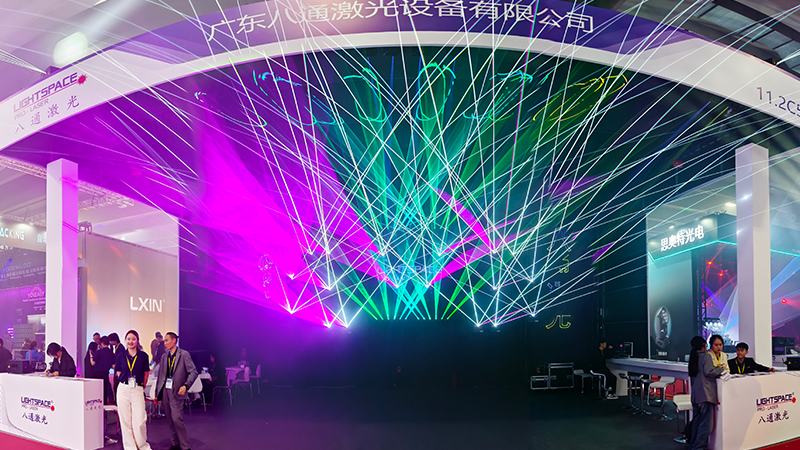
Different from ordinary outdoor lighting, the key advantage of outdoor laser lights is their “directionality” — the laser beam has an extremely small divergence angle, enabling long-distance projection, with a maximum coverage of several kilometers. This is why laser lights on high-rise buildings and mountain tops can become visual focal points. At the same time, it controls the high-speed deflection of the galvanometer through a computer, scanning up to tens of thousands of times per second, thereby converting the laser beam into dynamic text, patterns or animations. Combined with sound control, DMX512 control and other modes, it achieves synchronous linkage between light and shadow and sound.
The reason why outdoor laser lights can adapt to complex environments lies in their special protective design, such as sealed chassis and intelligent temperature control systems, which can resist harsh conditions such as wind, rain, high and low temperatures, and are suitable for use environments from -40℃ to 50℃. Whether it is square lighting, scenic spot light and shadow shows, or commercial advertisements, it can create a very dreamy visual effect with its bright colors, high brightness and easy control, becoming the “finishing touch” of outdoor night scenes.